

What I Learned About Lust From a Monk, a Marriage and a Breakdown
Plus Week 1 of the Seven Deadly Sins Writing Challenge


I discovered sexual pleasure at four, sliding down a bannister.
Delighted, I ran into the kitchen to tell my mother my discovery. I imagined her to be ignorant of this amazing gift. After all, I had never seen her slide down a bannister. Surely if she had a similar magic button, she would have taught me about it when she taught me about my body parts.
Her response surprised me. The exact words are elusive, but the gist was, “Very nice, dear, but keep it to yourself.”
So I did. Through the rest of my childhood, I privately enjoyed this capacity of the human body and became a highly sex-interested teenager and adult.
This isn’t lust. It is neither sinful nor shameful. Something that brings joy and hurts no one isn’t “going against God.” It is an inherent part of the human experience.
The sex drive is a natural and beautiful thing. Sex can be quite literally divine. It provides the means — if we wish it — to forge the deepest of connections with another human being, even to the point of feeling we have merged.
But separated from love, it can be – and frequently is – a destructive force. Welcome to Lust, the first of the seven deadly sins.

A sin is any thought or behaviour which separates us from our natural divinity.
The fact that children can discover sexual pleasure at a young age is not a call for adults (or older children) to sexually abuse them. What that does is damage their future capacity for sexual pleasure. Damage to others is one of the key markers that helps us recognise the difference between (divine) sexual pleasure and the sin of lust.
In my therapeutic practice (see this post for my many identities), I’ve worked with victims of rape and sexual assault, and their capacity for enjoying sex is severely affected. When people buy into the lie that “women don’t like sex”, they are missing the fact that this is often the cause. When official statistics show 1 in 4 women have been raped or sexually assaulted as an adult and 1 in 6 children have suffered sexual abuse, you know the real figures of these generally hidden, private, hard-to-report and even harder-to-prosecute crimes are much higher.**
This is just one example of what makes lust — the driver of abuse — the first of the deadly sins. But we mustn’t mistakenly think that the sexual urge itself — a natural capacity of the human body, arising in innocents — is sinful.

The confusion between desire and its distorted forms isn't unique to Western thinking. Even Buddhism, with its profound insights into the nature of suffering, has been misunderstood on this point.
English-language Buddhists tend to teach that desire is the cause of all suffering. Buddhist principles say that suffering is caused by craving or attachment (samudaya), and this is often referred to as desire. (For an excellent overview of what Buddhism really teaches about suffering, I recommend this piece.) The path out of suffering then becomes to release or quell desire. Even to the point that some Buddhists (and Krishnas) will recommend not eating onions or garlic because they “inflame the passions.”
But desire is not sinful; it is a fundamental component of our nature. Humans are desire engines, and no sooner have we attained what we desire, we start desiring something else. We are wired this way from birth. So to say desire is “bad” is as mistaken as the doctrine of original sin.
Desire is desirable. It is a creative force that summons life energy through us, seeding art, invention, scientific innovation, and social progress. From desire for a salted caramel ice-cream to a desire for justice and equality, it is a force for joy and progress. Some of our strongest desires are the ones that bind us person to person. A desire for belonging. A desire to love and be loved. And yes, sexual desire, which is (when not distorted) a strong path towards love, even for the wary and previously scarred. Desire is untainted, fully in alignment with our empowered (innately divine) inner selves.

It was when my daughter attended a Buddhist school that I first heard (in pujas) that Buddhists found desire undesirable. This seemed very wrong to a long-time fan of sex, especially one who had experienced the power of Tantra. I voiced my disquiet to a more knowledgeable parent who said this was based on a mistranslation. The right word was not “desire” but closer to “yearning”.
And this makes sense. Yearning is a state of lack. Think of “War on Want” (how well-meaning yet spiritually unaware can a campaign be!) and you’ll feel the lack inherent in “want” and its meatier cousin “yearning”. When we focus on absence, what we long for cannot arrive, since we will only draw towards us the object of our focus. That is indeed a powerful source of suffering.
Furthermore, the quest to “quell” passion is both impossible and undesirable. Impossible because when we fight to eliminate something, we are giving it our focus (hence what we resist persists). And undesirable because passion is at the heart of our divinity. (Again, I find myself considering the distortions of Christianity, how they have successfully associated the word “Passion” with suffering and torment!)
Consider that form of passion known as “enthusiasm”. It’s Greek roots en-theos: in God. Enthusiasm and passion are fuelled by divine inspiration. The last thing we should want is to snuff that energy out.
Though attempting to “quell” anything is both pointless and unproductive, “releasing” it can be helpful. This is part of the three-part skeleton key that unlocks our full power. Revel in the deliciousness of desire by all means, but before it stagnates into want or rots into yearning, let it go. Trust that the seed is planted, and release any need or urgency around it: simply (as hard as that actually is!) surrender to life as it is. It is trying to take what we want by force, or mourning the fact that it has not come, that separates us from our divinity (“sin”).
Because unhappy, lackful states are the opposite of what we are at core. Which is not to say they don’t have their uses. In these states, we launch desires for life to be otherwise, and those desires have a creative force. But in these states, we are not fully connected to our power. We are devices calibrated for improvement but unplugged from the mains. To re-plug ourselves into that power, we must find a way to love What Is. (Personal example linked below):


We can lust for more things than sex, of course. For money. For power. Indeed, it is fair to say—as numerous feminists have observed—that rape is more of a lust for power than sexual release. Sexual release, after all, is at everyone’s fingertips.
But let’s stay focused on carnal lust. And how it has numerous ways—beyond the harming of others—to separate us from love.
The urge for conquest
Like a week-old helium balloon, my hand drifts up. This is not a purely masculine sin. When a disempowered childhood dumped me in an adulthood which deemed women weak and second-rate, I found I had one singular power: seduction. My most shameful moment, aged 19: a housemate’s friend visiting for the weekend. A monk in training, not far from holy orders. Lit up by curiosity, I set out to test both the extent of my powers and the limits of his religious commitment.
He failed. And I don’t think I have ever felt so dirty, so ashamed of myself. I sat afterwards in a deep, scalding bath, trying to scrub myself clean of the sin that was far too deep inside to loofah. I’d not even felt attracted to him. I’d “won” but my prize was self-loathing and guilt.
The quest for novelty
One conquest at a time, notches on the bedpost. A university friend was attempting to collect, between the sheets, every letter of the alphabet. She ruined our friendship when she collected my brother as her “D” and told me – seriously, Lou? – he was well-endowed. I wonder how far she had to fly to find Zachary and Xavier. Or how miserable she made herself in the achievement.
The suppression of desire
As discussed, “suppression” has the opposite effect. Why else have so many Catholic priests turned abusers? I had my own taste of the uselessness of denying my natural urges in marriage number one.
The man who would become my first husband wasn’t just a bunch of red flags before that term existed. He had other critical drawbacks. Which, in a powerful act of self-harm, I decided to ignore. Months into dating, he was reluctant to go beyond kissing, which spiked my curiosity and the urge to test him (see monk above; I had not learned my lesson). The reason: testicular cancer treatment (or the psychological effects of that) had left him functionally impotent. Semi was as far as he could go. Viagra was years away, and attempting sex was like trying to push a marshmallow into a coin slot.
How far my self-loathing went at this point is extremely clear: despite having a very high sex drive, I knowingly — in my twenties! — put myself into a sexless marriage. This was never going to end well. Even if it hadn’t been abusive.
Lustfully lackful
Emerging from the back end of this relationship with three little boys* and no sex life, lust was a relentless companion. A poem from this time is fairly typical of what was going on for me:
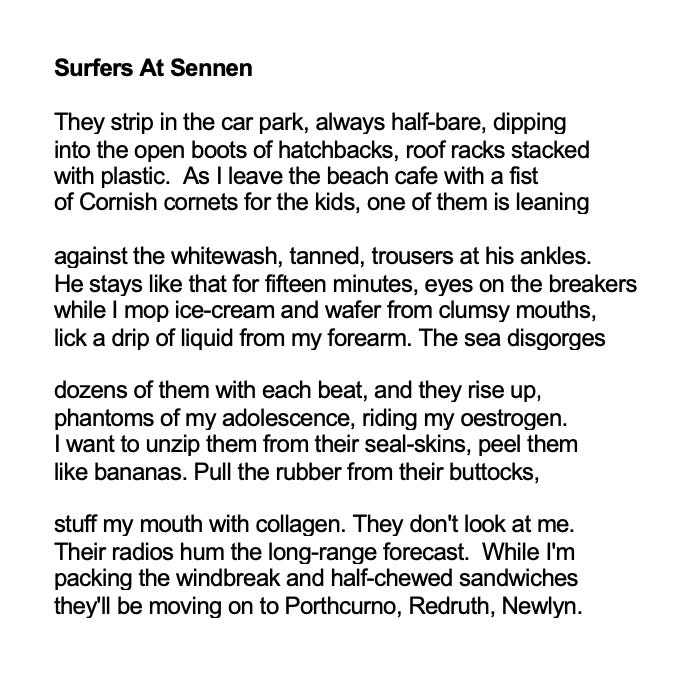
*Marshmallows can be forced into coin slots. At which point they might, due to the novelty, ejaculate in surprise, much like the heroes of early 20th-century children’s books.
My initial response to escape was relief, but lust resulting from years of pent-up desire? That put me in a state of near-permanent envy. I remember wandering around Aldeburgh one night, looking up at lit bedroom windows, in tears as I imagined absolutely everyone around me was having sex. Which is (if you know the place) extremely unlikely. And in due course, my desire for sex (the meaningful kind, where I wasn’t a piece of meat) separated me from my divinity to the extent that it drove me to the edge of suicide.
This kind of lust, where we focus on our lack of sexual satisfaction, separates us from love with the precision of medical tweezers. That neediness is only a magnet for more of the same. The very energy that should connect us to others becomes a barrier, a grasping that repels rather than attracts.

No doubt you can think of other ways that lust can push us away from love. Can look to your own life, perhaps, and see where desire segued into lust and caused you pain. And you’ll be lucky, I think, if you were the only one knocked from alignment. The greater the sin (the deeper the hurts caused to others), the harder it is to return to self-love and compassion.
Yet, we are all human. We have all sinned. The wiring for desire is innate. Sexual desire is what drives us to procreate, after all. Without this drive, humanity wouldn’t exist. And is there a single one of us who hasn’t slid from sexual desire to lust, and caused this separation?
Desire feels delicious, but love? Do we want to be separate from love?
The key to returning to love is twofold: allow and release. Be it desire or a painful emotion: allow and release.
This is non-grasping. This is flow. And this is the skeleton key that unlocks every door.
Thank you for being here. Share if this resonates, and please light up the ❤️ if you enjoyed it! Likes make an enormous (and positive) difference to how many people will see this piece.
Below, for my paid subscribers — the ones keeping me afloat in an uncertain world — there is more as a thank you: Week 1 of the Seven Deadly Sins Writing Challenge. RELEASE THE SIN OF LUST with the phenomenal power of words. YOU KNOW YOU WANT TO!
ENDNOTE: ** Statistics vary, of course, but these from the Centre for Action on Rape and Abuse are roughly in line with other sources and presented in a starkly digestible format. The statistic for men is 1 in 20. I recognise the suffering of all who suffer rape and sexual assault; here I am focused on the idea that women enjoy sex less than men do, and/or are less interested in it, and what I consider one of the important factors in this that is often ignored.
Keep reading with a 7-day free trial
Subscribe to How to Evolve to keep reading this post and get 7 days of free access to the full post archives.