

Prizewinner and Dogshit in the Same Evening
On imposter syndrome, class damage, and finding champions in hostile rooms

“Like” this post to extinguish your imposter syndrome forever! Okay, maybe not. But anything’s worth a try, right? ❤️
Monday night, I was in London for the celebration of an amazing woman’s life. Dozens of talented people — actors, singers, musicians, dancers — gathered to perform her work, while her husband, daughter, and friends spoke about her brilliant, fierce energy.
I first met her about 14 years ago. Last year I twice had dinner with her in close company, and felt the power of the full beam of her interest as we found we had strong, spiritual, common ground. She sent me a book, I read it, we emailed each other. Then in November, suddenly, she had a cancer diagnosis. When I last emailed her, just before Christmas, she was full of hope. A month later, she was gone.
Monday night, at times, I felt like an imposter. Surely everyone there knew her better, or longer; had a deeper loss. Yet still, I felt robbed. Of our friendship, only just blooming. The grief of not having had more time with her.
Remnants of my childhood damage often give me the sense of being “less than.” The voice in my head says I don’t really belong in rooms where accomplished people gather. That I’m tolerated rather than wanted.
This was a woman who’d worked with some of the finest actors and musicians in Britain. She didn’t do false flattery or polite encouragement. When she looked at you and told you that you belonged, she meant it.
She would have had none of this bollocks from me. She was fierce in her buoying up of those she believed in. And as I took my seat, I heard her voice clearly say, “You belong here too.”

So many of us feel “not good enough.” I have a stripe of “not good enough” right through my core, like a stick of Brighton rock.
I used to say I didn’t have imposter syndrome on the grounds that I knew — have always believed (in the early days, delusionally)— that I was a top-notch writer. Millions of words of practice, and the self-knowledge that followed a mental breakdown, eventually raised my skillset to match the level of my delusion. In 2012, I finally had my breakthrough with the publication of The Marlowe Papers, a 70,000-word novel written entirely in iambic pentameter. Won the Desmond Elliott Prize, and the Author’s Club Best First Novel Award; was longlisted for the Women’s Prize. Will Self called it ‘The most complete Marlowe I’ve ever encountered.’ It had rave reviews from the TLS, Literary Review, The Financial Times, The Telegraph, The Express. It made The Observer Books of the Year list. After years of being told I wasn’t literary enough, wasn’t good enough, here was undeniable proof: I belonged.
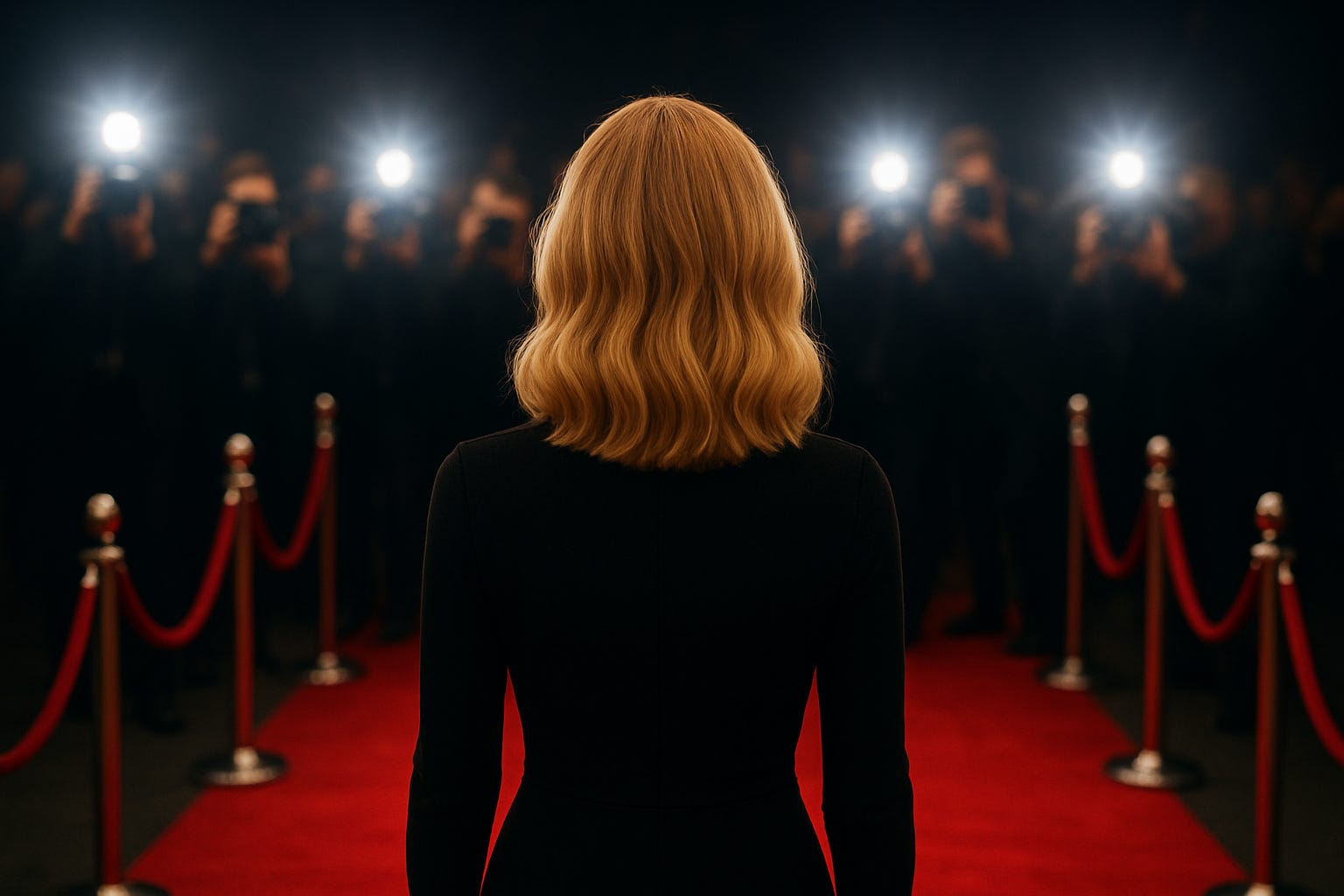
My longlisting for the Women’s Prize was particularly special. It had, at the time, the best literary party, complete with an actual red carpet, haunted by paparazzi. Actual celebs in attendance. Quality champagne and astonishing canapés liberally administered by circulating waitstaff; party bags which included a full-size bottle of Baileys liqueur. Dazzled on arrival, I was blessed to be instantly adopted by former Literary Editor of the Independent, Suzi Feay, a judge of one of the prizes I’d won, and the author of the rave in the Financial Times.
She’s a very special person, Suzi, working class sensibilities, no snobbery, and she’s also as well-connected as they come, so her taking me by the elbow and steering me around the room was like being handed the correct fork at a dinner where everyone else was born knowing which one to use.
She was my pass into the literary world; her conviction that I belonged there was the secret handshake. First, she introduced me to Zadie Smith. Then she identified various novelists around us. Who did I most want to talk to? I chose Barbara Trapido so I could finally tell her, some thirty years after reading it, that Brother of the More Famous Jack blew me away. We discussed (because I’d read it somewhere) her habit of writing longhand.
And that night, I have never felt so welcomed. I belonged. Here was my crowd. I’d spent years on the edges of poetry, always feeling Not Accepted by the Poetry World. Numerous book launches, prizegivings, readings and parties. Three times I’d attended the National Poetry Competition Party as one of final ten, clutching my “Highly Commended”, and never felt welcomed, except—in one of the most memorable evenings of my life—by that beautiful soul, Michael Donaghy.
On the top floor of the Tate Modern, with spectacular night-time views across the Thames, I’ve just been introduced to the winner of the Ted Hughes award by a mutual friend. The winner turns to our mutual and asks,
“WHY are you introducing me to this person?”
Like I am a piece of dogshit under her shoe. She glares at the mutual. Stalks off to find someone important to talk to. The mutual crumbles, heading for the wine. I stay there, like the lump of crap that I am, stinking up the place with my irrelevance. Trying to breathe-dissolve the lump in my throat, the threatening tears. When behind me, in a blast of mid-Atlantic vowels, the loudest and most delighted voice exclaims
“ROS BARBER!”
I turn. Lock on to the wide smile of the best damn poet in the room as he strides towards me and unexpectedly scoops me into a hug. Yes, we were friends, but he was everybody’s friend. One time, he’d offered to give me a lift to Victoria, after cooking Mexican food at Poetry Society HQ, but his car was clamped. We waited an hour for the clampers, chatting, until it got to the point I would miss the last train. But I’d never been lifted and twirled in the air.
I told him what happened. He said, “Screw these people!” We abandoned the g/litterati for the pub and got properly blotto.
But once he died, I was back to feeling like I didn’t belong in those rooms. So to find that sense of belonging at the glitziest prize-giving party in the calendar (okay, I’ve not been to the Booker) was something rare.
But note what I needed was a champion. Someone to take my elbow and steer me round the room. If I could hire a Suzi, every time I have to enter a room full of accomplished people, I’d be just fine. So where is my inner Suzi?

When I was a kid, she fell down the crack of the sofa. The cracks in the pavement. The cracks in my parents’ marriage. At five, I was invincible, certain of my genius. At nine, I was in trouble. Between those two ages, I lost my inner Suzi. When your parents marry people who hate you, where is the sense that you matter at all?
State school didn’t help. Had my parents been wealthy (or put me up for a scholarship), they could have replaced my Inner Suzi by coughing up school fees. The privately educated waltz round those parties, quite sure they belong. I spoke to Boris Johnson’s father at one of those parties, not knowing (until he told me) who he was.
“Comprehensive school?” he asked, out of nowhere. “I can always tell.”
It’s the lack of an Inner Suzi. Completely detectable to the born-to-rule.
But I’m not alone, as a writer with no inner Suzi. This week, even as I’m mulling this over, Linda Carroll writes about Maya Angelou, Virginia Woolf, Kafka, Steinbeck, and so many great writers, all feeling deeply unworthy. What’s notable is how all of those writers had fractured, disrupted childhoods and/or humble beginnings. Virginia Woolf, we know, was abused, and how many others. Statistics published this week in the UK show that 30% of adults were abused as children: and that’s now, in 2025. It wasn’t better in the past, when smacking was standard, and kids were assumed barely human. I am part of that 30%.
It really isn’t hard to give a person lifelong issues with self-worth. Parents, lost in their own dysfunction, do it all the time. If your parents can’t give you unconditional love, how can you?

The mission to find your Inner Suzi is the mission. Finding our way back to the self-love we were born with, piece by piece.
Here’s what that fierce, brilliant woman would tell you—what she told me with her full-beam attention—you already belong. The damage is lying to you. Every room that makes you feel ‘less than’ needs you in it, needs your different story, your state school sensibilities, your hard-won wisdom.
Our time on this earth is too short to wait for permission. If someone fierce and brilliant believes you belong somewhere, trust it. Hell, trust me, someone who’s been both prizewinner and dogshit under the shoe, sometimes in the same evening. If Michael Donaghy could scoop up this piece of comprehensive school damage and make her feel like she belonged, I can pass that on to you.
Note to self, Ros. Note to bloody self.
Because you are enough. We all are. Even when we can’t feel it yet.

It really helps me if you light the heart! ❤️ One little click for you, extra readers for me!
Incidentally, on the subject of class, my good friends The Indelicates wrote the ultimate song. This is your outtro if you’re leaving me here:
For full members below the paywall: after our last session went so well, I’ll be going forward with the online EFT tapping circle once a month. As promised, November will be all about clearing anger. The session is scheduled for Friday Nov 28th at 19:00 GMT. You’ll need to register in advance: registration links below. 💜
Keep reading with a 7-day free trial
Subscribe to How to Evolve to keep reading this post and get 7 days of free access to the full post archives.