

The Senseless 'I Will'
What happens when your gut says no and your mouth says yes
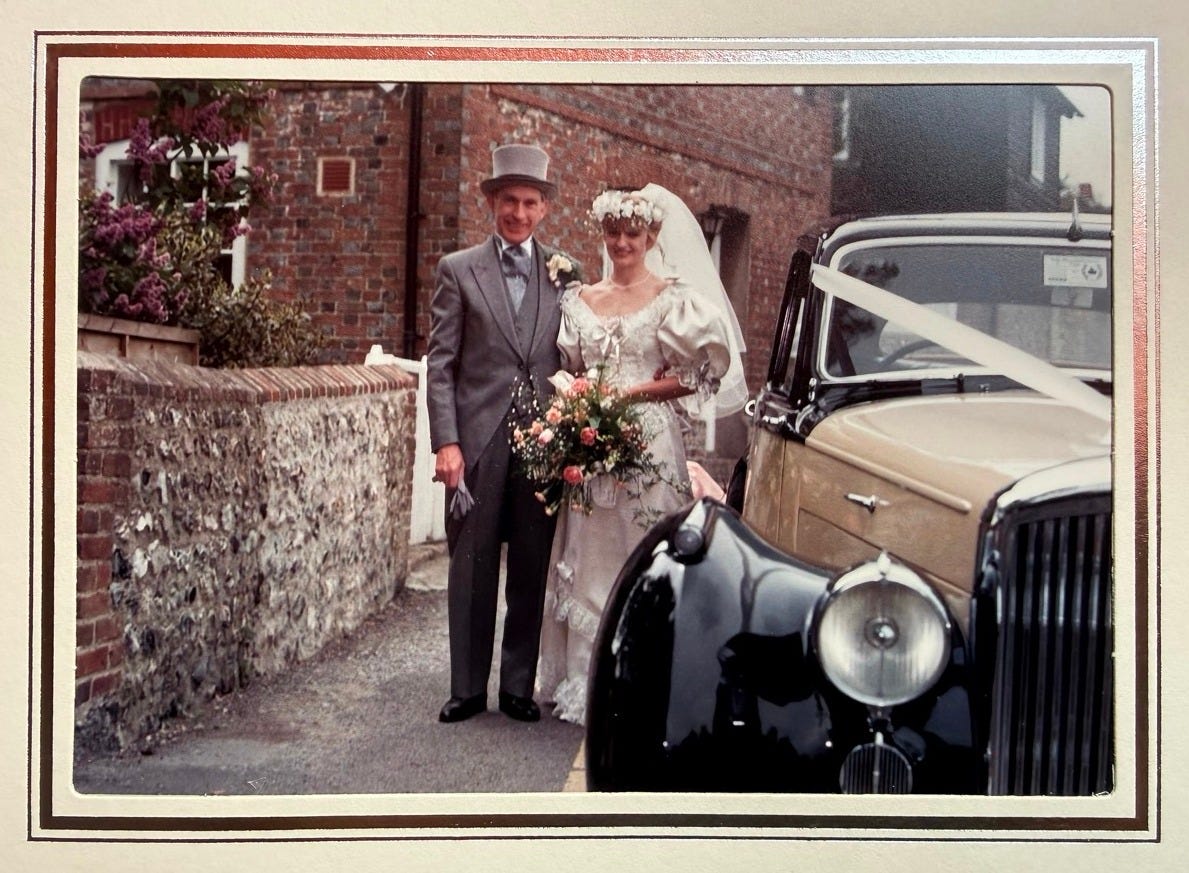
The Senseless I Will
“Wives, submit yourself unto your own husbands, as unto the Lord. For the husband is the head of the wife—”
I didn’t authorise this. But I’d given the vicar free rein. Now he’s spooling Ephesians over my head. Submit. Obey.
I stand at the altar of St. Peter’s Church in Rodmell. The saint of my brother’s name. No doubt he’s with me, though at this point, I have no faith of any kind. I think of him only as lost. But I am the one who is lost.
The church wedding was Walter’s request.* More than request, in truth. “Registry Office weddings aren’t valid,” he said. He calls himself Christian, though he never attends. The boarding school he attended from five: a cathedral school, which put him in the choir, and beat him for writing letters to his Mum that said, “I hate it here.” Masters beat him repeatedly until he learned to sing hymns and write letters of soothing lies. That was enough to make the church feel like family. His sister calls herself Christian, too. Unlike him, she attends her local church every Sunday and arranges the flowers on the aisles. But unlike Christ, she judges me constantly. Spikes me with words that Walter insists I ignore. “It’s just who she is,” he says.
His parents, who stand now at my back, call themselves Christians too. His father, Jerry, recently retired from the Diplomatic Service, his belly pregnant with fine dining and after-dinner brandies, adjusts the old school tie. His mother, June, white curls around a Southern Irish voice and smoker’s mouth, has a musical laugh and a cardinal two branches back on the family tree. With their stories of dining with Indira Gandhi, Imran Khan, and Prince Philip — who, seated next to June, let out a fart, then famously said “Don’t worry, I’ll say it was me” — they’ve retired to South Wales.
If it had to be a church, I figured, let’s make it a meaningful one. Virginia Woolf is my touchstone. We share a birthday. I’ve read her diaries, and I nurture a sense of companionship with Virginia, soul sister in despair. Because I still nurse a private darkness. Wounds I’ve no idea how to heal. Walter and I got a dog, as part of the process that tangled me into commitment. A regular weekend walk is to the river at Rodmell. A mud-clod pilgrimage from Virginia’s cottage to the river where she drowned herself, loading her pockets with stones, in the middle of the war. I’ve often stood at the raised banks of this river: the Ouse. Which, like its name, is muddy and uninviting. Fast-flowing when the fields have emptied themselves of rain. Water would never be my exit. I can’t imagine doing what she did. But I can imagine life in her cottage. Its garden backing onto the churchyard. This pretty church.
If I had to get married in church, shouldn’t it be this one, connecting me, through its literary bloodline, to a writer I love and admire? But how to get married there, out of my parish? Oh, the lengths I had to go to. Attending every Sunday for six full months before the banns were read. I couldn’t fake believing in God. But I could say honestly, yes, I was seeking. Because, on some level, I was.
I was raised a good atheist. My parents were scientists. Though my mum had been a Christian Scientist once. But on a Sunday walk by an English canal when my brothers were two, she watched a toddler drown in a weir. Lost her faith in a handful of minutes, as the parents and other adults dove in and searched the tumbling waters to rescue the child so similar in age to her own. But he wasn’t saved. His body was quietly drawn by the current along the canal bed and swept away while the frantic adults continued to search the spot where he’d fallen in. The mother screaming, then sobbing, on the tow path, my mother’s arm around her, useless, useless. She told me that was the day she gave up God. Because how could there be a God if that could happen? And if there was a God, then he wasn’t very nice to be killing toddlers for no reason she could fathom. So she was Godless before I was born.
For a short while, she sent me and my siblings to Sunday School. Mr Wiffen and his one built-up shoe, the short leg due to polio. Colouring in a picture of the Good Samaritan putting the injured traveller on his donkey. Making dried palm leaves into crosses. I was only sent there so my parents could argue in peace. And when they split, it stopped.
Until they lined us up on the sofa and broke the news, I had no idea my parents were even unhappy. Though my Mum did slap me more than I deserved. Red palm prints stinging the back of my thighs for hours. When I said, “It’s not fair,” she told me, “Life’s not fair.” And there was that time I was picked up from school by the neighbour, Jean. Mum wasn’t home for days, and no one said why. And many years later, I found out she’d taken an overdose that day. Was in Severalls, the mental hospital, a scare-place bandied about at school. It was all hushed up. They never rowed, that I knew of. My mum was just silently sinking into despair.
My own despair began once hers abated. As though it was handed on, mother to daughter. She abandoned the good ship motherhood for the shore of another relationship and left me alone in a sea of feelings, mostly buoyed by anger, but sometimes drowning. And no question, as I weighed my life, the value of it, in the following years — mostly in notebooks, sometimes on a footbridge over a four-lane road — I wandered sometimes into churches. Asked the crisp curves of the rafters, Is anyone there? Stood in the aisle waiting for something to happen. For light to stream through the window and gift me peace.
So it’s not a lie, this statement “I’m a seeker”. The lay preacher invites me for faith-exploring evenings with others like me. But they’re not like me. They don’t ask difficult questions. Or get pat answers that don’t seem like answers at all. When he starts to suggest I head towards confirmation, I give it up. Nothing’s confirmed, besides the banns. It’s all up in the air.
Except this one thing now: the wedding date (lucky twelfth). And around it, other things get confirmed: the design and colour of the bridesmaid’s dresses, the number of bridesmaids (lucky six). The reception venue (grand, with gardens). The design of the dress that my mother will make in silk, which I order from a flagship store, rushing there on the tube in my lunch hour from my work in Moorgate. And the meal is fixed (roast beef, he insists), and the seating plan, and the flowers, and the gift list, and the vintage Bentley in cream and black with its long ribboned bonnet.
And the church. The perfect marriage venue for a Woolf lover.
Wolf lover. I used to joke with a writer friend about the wolves in Angela Carter’s Bloody Chamber. Men who were “hairy on the inside”. I think this man I’m marrying isn’t a wolf. Nothing predatory about him, surely. Isn’t he more like a father figure? Protective? Yet. There have been moments. Snags in the fabric of my comfortable story.
A double date with our work friends Mike and Marjory. Walter is driving the four of us somewhere. Men in the front, women in the back. Mike floats a hypothetical question.
“What would you do if you found out she cheated on you?”
Walter drags on the Rothmans. Taps the sparks through the open top inch of the window.
“I’d kill her,” he says, matter-of-factly.
I catch his eyes in the rear-view mirror. They are cold as a marble slab. This isn’t a joke.
Did I say anything? I don’t remember saying anything. What could I say that wouldn’t make his next words more frightening? His diamond was glinting on my finger. I’m engaged to this man. What he said: it’s a blip. Out of character. He’s I’ll get the round in, hearty laughs, bonhomie. I turn my face to the glittering dark. Ride through the moment. Seconds pass. Then minutes, then months.
Not long before my wedding, I sit with him in front of the evening news. It’s three weeks since the riot at Strangeways Prison that led to prisoners taking control of the building. Three weeks of ongoing protest. They’ve unfurled banners over the roof and out of windows: “Inhumane conditions”, “Innocent until proven guilty”. Most of the prisoners there are on remand. They’re protesting at 23-hour-a-day lock-ins, physical assault, the use of the chemical cosh to control them. “We want to speak to MPs”, the banners say. “Media contact now.”
“They should just go in and shoot them,” Walter says.
Incredibly calm. Matter of fact. I can hardly believe it’s come out of his mouth.
“But a lot of them aren’t even proven guilty of a crime!” I say. “There are teenagers in there. And nothing in this country is a capital offence.”
“Shoot them, get it over with,” he says. “It’s costing taxpayers money.”
I’m enraged. And soon, I’m standing up, shouting at him, and he’s laughing at me. He drives me so crazy that I snatch the wine bottle that both of us emptied and throw it at his feet.
It bounces, and he laughs even more.
“You’re pathetic,” he says. “Go on! Have another go!”
I can’t bear it. This man. Who the hell am I marrying? I can’t bear to be with him another second. In tears, I grab my keys and purse, walk blindly out of the house, no idea where I’m going. I must get as far away from him as I can. I walk to the station, catch a train to London, calling my friend on the way. I reach her flat in Streatham at 11 pm. She’s ironing a pile of knickers. I don’t understand why anyone would do that. Ironing’s hateful, and knickers don’t even need ironing. She says she enjoys it. Finds it soothing. And what’s all this about then?
I tell her about the argument. The things he said. His callous disregard for life. The way he mocked me for having compassion for them.
She sits me down.
“Has he ever said anything like this before?”
“No.”
“Maybe it’s pressure,” she says. “Maybe it’s nerves. Imminent weddings do funny things to people. I remember when Ian and I were about to get married—”
Her story doesn’t involve Ian saying people should be executed without trial.
“He was so heartless.”
“Maybe it was a joke to wind you up.”
“So infuriating though.”
“Men are infuriating,” she laughs.
“I don’t think I want to marry him. How can I marry a man like that?”
I talk it through. The wedding is huge, expensive, paid for — and three weeks away. I decide it was just a stupid argument. Stress about the big day. Pre-wedding jitters manifesting as a political disagreement. So the next morning, I go home to him and carry on as if nothing happened. I don’t call it off.
The cruelty I saw that night, the casual disregard for human life, the mockery and amusement at my distress, was a trailer for the feature film I was about to live through. But the seating arrangements were confirmed, the guests had bought presents, my mother had hand-made a dress in real silk with pearl-beaded lace, to my size and specifications. I was twenty-six, and thought calling off a wedding three weeks out would be more catastrophic than marrying someone who thought shooting prisoners was a reasonable policy.
And didn’t I already have cold feet? That dog I’d bought with him, when I walked him alone, I’d find myself talking out loud, arguing myself again and again into going ahead. Cold feet, it’s just cold feet, I told myself. And everyone gets cold feet. I talked it through with my mother, and she agreed. Cold feet, cold feet. And now my feet are so frozen I barely feel them. Which is just as well, pinched into those bridal shoes.
If I was going to call it off, those were the times. Before I was here, at the altar.
“Wilt thou have this man to thy wedded husband?”
“I will.”
With the words escaped from my lips, my hearing muffles. I’m underwater. A high-pitched note rings through my head, as though angels sing warning at the top of my audible range. The service continues. I have to pretend. When prompted, I repeat the words the vicar is mouthing. But I cannot hear them.
It’s as though my ears can’t believe what they heard, and popped. Gave up, shut down, we’re done. You agreed to this? say my ears. We don’t want to hear another word.
The deafness continues while I sign the registry book. While I walk back up the aisle and emerge into sunshine, applause, and confetti. While photos are snapped. While I run to the beribboned Bentley. While I take my seat beside Walter, who, full of his happiness, pours us both champagne in the back of the car. While the car makes its way to the grand country house my dad has hired for the reception, where the first piece of business is The Receiving Line.
I stand and wait beside Walter, a newly-filled flute in my hand. The guests arrive, queuing up one by one and two by two to say the same thing. I am guessing and nodding, smiling and secretly deaf.
Congratulations! they mouth at me. Congratulations! Congratulations!
I cannot hear a bloody thing.

❤️ If you enjoyed this post, please let me know ❤️
*Names have been changed to protect the innocent (me) from potential lawsuits.
How about you? Did you walk into a marriage trap? Did you blame yourself? If the answer to these questions is yes, I want you to ask yourself these questions aloud.
Have I forgiven myself fully?
Do I trust my instincts now?
Feel the answer to these. A ‘no’ is a contraction, a tightness, a zing of negative emotion… and maybe, if you’re lucky, you’ll hear an inner NO.
If you get a ‘no’ to either question, scroll down to the bottom of this post for the reframes you can use to completely release yourself from self-blame.
If you’d like more pieces like this in your inbox
If you’d like to say a heartier thank you

Are you working on a novel? Would you like to? Join The Manuscript Club! Starting September 1st, a bunch of us are working on our novels together, with encouragement, accountability, community, craft posts and feedback. Details here.

Why I Stole Your Life — join the serialised read

“The curse of Eve, as I have understood it on my short time on this earth, is a great nuisance to all women, but especially so to those women who choose to live outside their sex, as I do. Nevertheless I will not have the course of my life undone by some ancient minikin’s urge to eat fruit.”
Catch up on the story with these chapters:
The Secret of Bleeding is to Bleed in Secret

Mary, disguised as a boy both for survival and its freedoms, has found a close friend in the barrow boy Jim Coker. She binds her growing breasts and smokes to deepen her voice — but puberty is relent…
You Need Not Be a Child to the Parent
Mary’s quest to stay disguised as a boy continues to be challenged by puberty. How to deal with periods? There is one person in London who knows she is female, will not reveal it, and might be able t…
Okay, here we are. The fabled ‘bottom of the post’. You made it!
Right — back to that ‘no’ you felt, assuming you felt one.
I’m slipping this section behind a paywall, because this kind of work deserves people who’ve chosen to be here, not passers-by. You can grab a 7-day free trial as your ticket through, and you’ll get a bunch of goodies alongside (everything paid subscribers get) and some time to work with the reframes that demolish self-blame.
Keep reading with a 7-day free trial
Subscribe to How to Evolve to keep reading this post and get 7 days of free access to the full post archives.