


Firstly, a hearty welcome to my new paid subscribers! You have tipped me over the edge in the best way: I now have a “Bestseller” tick by my name in the Substack app.
This helps me in numerous ways. It’s a badge of “social proof” that helps other people find me and trust that I’m offering something of value. And when potential publishers are deciding whether to publish my book, maybe it will help a little there, too. (I wish I could give you news of that, but I am not allowed!)
Since this is a two-way relationship, here’s a little something that may help you in return, with the potential to pay you back manyfold for the subscription. I say this because I know that one or two of you are subscribing on a tight budget, which I relate to and very much appreciate. As I sail ever further away from the final dregs of my redundancy payout, I too am ultra-aware of the in/out balance.
But it’s never worthwhile skimping on those things in our lives that make a positive difference to how we feel. What looks like a luxury to some might be exactly the uplift that brings the next piece of goodness into our lives. Emotional relief and uplift are a vital part of surviving and thriving in these crazy times, and as ever, this is where my heart is focused as I write to you.
As my life returns more or less to normal after the gorgeous experience of having my piece published in Modern Love, I’m returning my focus to the Seven Deadly Sins, which we left at greed, without the usual “writing challenge” follow-up.
If you’re new here…
To get up to speed with my thinking: no, I’m not a Christian. I sometimes refer to myself as a “lapsed atheist”. Spawned1 by two scientists, I have slid through the window of epigenetics, quantum physics and consciousness studies to a place that fits into the checkbox “spiritual not religious,” but with a practical grounding.
I’m fascinated by the concept of sin as an action that only increases the distance between where I am and my core state: embodying love.
Those things named as “sins” are normal human propensities. And they are also what separate us from living a life that’s (in all ways) divine.
So, shall we dig further into greed? Because, as usual, I have a slightly different take on it. My focus isn’t “don’t be greedy” (were you told that as a child? I was). It’s to pose this question. Is fear of being greedy suppressing your income?
I’m not sure it’s a writing challenge. It’s more of a mindset challenge. It’s one I have wrestled with for a while, and as you can tell from my mention of budgetary constraints, I’ve not quite overthrown it. I intend, this week, to get it smacking the canvas in submission so I can move on with some of my more ambitious plans. And if your finances are in any way strained, I invite you to join me.

We’re all agreed, I think, that greed is BAD. It is one of the seven deadly sins, after all. It drives people to theft and other crimes. It turns billionaires into megalomaniacs who seem keen to destroy the planet, abolish democracy, fund war and genocide and subjugate women. (But enough of mood-supressing politics).
Yes, greed is something we non-sociopaths tend to avoid. We would hate for anyone to think we were greedy.
But this has unintended consequences. A lot of very GOOD people are powerless because they don’t have the money to fund counter-initiatives, make significant charitable donations, or indeed, even speak out. A lot of us are so hamstrung by the need to pay our bills, buy food, and keep a roof over our heads that we find we can’t speak freely for fear of losing the means to survive.
If we were wealthy, we would have all of these freedoms. We would have ease in our lives: more choices about how we spend our time. But those of us who have come to associate wealth with being “one of the bad guys”, well why would we ever let ourselves become one of those?
So subconsciously, we limit ourselves financially. We may be entirely unconscious of this; it won’t feel like we’ve made a choice to stay skint. It will feel like “circumstances.” Yet opportunities will have passed by us (unseen) because of our aversion to being “bad people.” I’m reminded as I write this of Derren Brown’s programme exploring how people’s belief in being lucky or unlucky has real-world consequences: the “unlucky” butcher missing every financial opportunity (a free TV, a free £20, and finally, walking right past a £50 note).
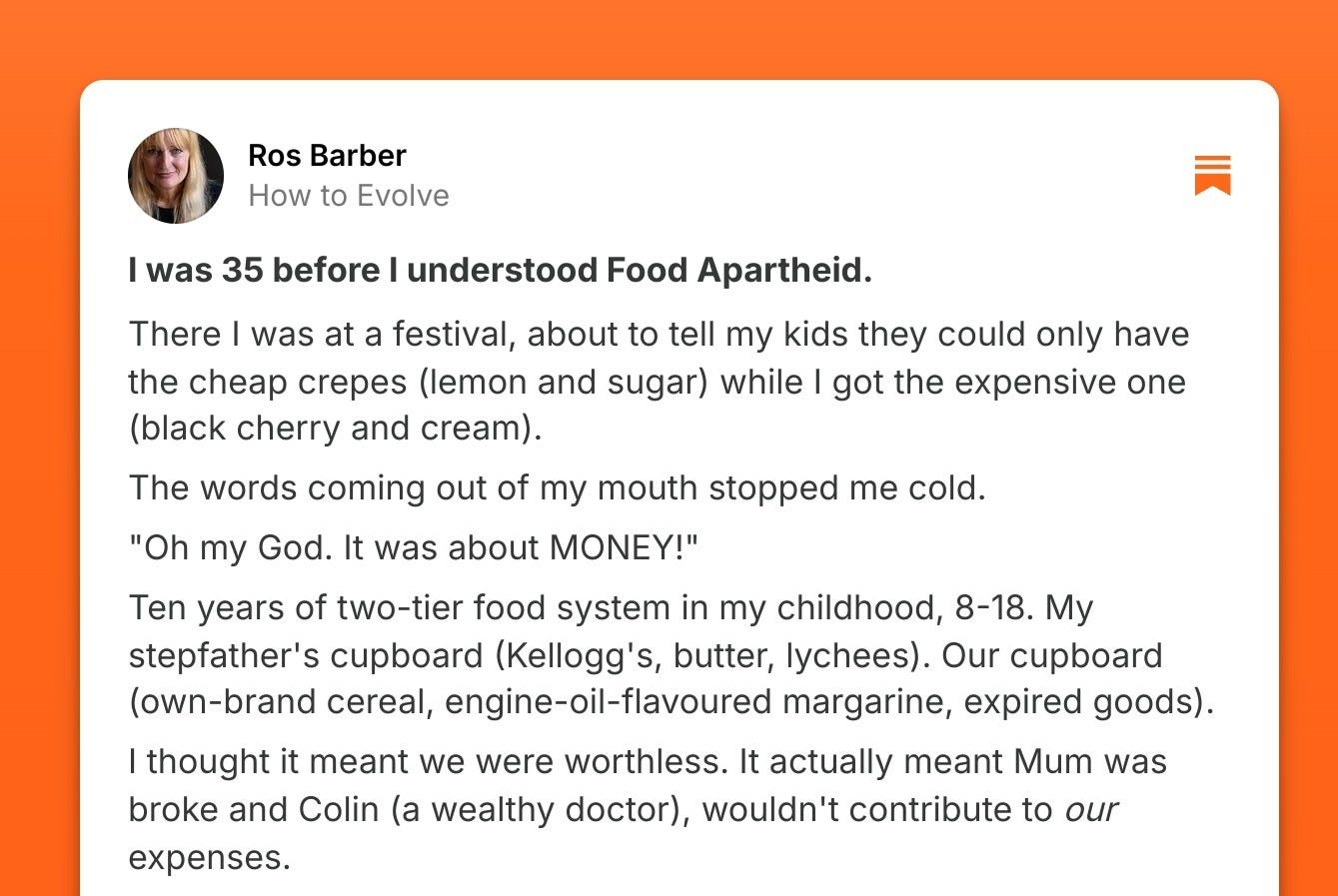
My personal programming around wealth being for “bad people” and therefore not for me began with my stepfather. This man was not a happy feature of my childhood. He was wealthy and extremely stingy. He was especially stingy when it came to us, the children who were living under his roof, which led to the most damaging daily fact of our childhood, food apartheid: something that profoundly undermined our self-esteem.
With a broader view I can understand money was his security: a very young child during the war, who was taken around the country by his actress mother and frequently left with relatives, he was not only subject to the privations of food rationing (which might explain why food was something he would spend money on it, at least for himself) but also general financial precariousness.
Nevertheless, this man I hated throughout childhood was my first model of “wealthy people are bad people". If you have financial issues, it’s very possible you have a similar figure in your childhood. Someone who was rich and mean. It becomes a powerful archetype we want to avoid, even though we may find our programming leads us, cash-strapped, into the heartbreaking position of that line in George Saunder’s Sticks. In this, the greatest masterpiece of flash fiction, I know, the kids of just such a man, when they grew up and had children, “found the seeds of meanness blooming also within us.” To my horror, I found that too.
Discovering this, determined not to be like that mean bastard, I have fought that meanness with everything I can muster. Forced myself into generosity I can’t afford. Propelled myself into (generous) debt.
Those of us who have come to associate wealth with greed also undercharge. My husband is a (generous) case in point. He charges “pay what you can afford”. This is admirable, but since he only tends to work with people who have nothing (they’re his kind of people), his income makes zero contribution to our coffers, and I must (and have for twenty years) cover all the bills.2
For my own undercharging tendency, I’ve had to practice, repeatedly, the sentence “my hourly rate is ___”. After failing to name it and taking freelance work so poorly paid that I resent it, I have even stuck this sentence on a post-it above my computer. And still it feels icky.
I now belong to a speaker community where people charge £10,000 for a morning’s workshop, and I really have no idea how they comfortably negotiate that. And yet, if I could do that (and I’m sure my workshops are every bit as powerful and transformative as theirs), I could work for ten days a year, and spend the rest of my time writing. So, in my avoidance of appearing greedy (which members of that community would call charging what they’re worth), I continue in financial uncertainty.
Our fear of being “greedy” keeps us skint.
And being (relatively) skint makes us (relatively) powerless. Not only because we can’t financially help where we’d love to. But because we can find ourselves living in a state of low-level anxiety that depresses our mood and keeps us from attaining the joy and relief that allows better things to flow to us (see the examples below).
Examples (from my life) of higher mood allowing better things to arrive:


But what if we could see money as neutral? As just a form of energy that flows to us and from us, in accordance with our comfort with receiving it, and our optimism about it? (See this study.3) What if we can accept that we are good people whether we are wealthy or not? That having more money won’t turn us into sociopaths.4 That actually, by empowering us into a life of greater ease and generosity, it might give us some way of doing something about the sociopaths. Or at the very least, give us a cushion that makes us less prey to their whims.
If you’re financially precarious, a mindset shift can have measurable results. From my past successes in this arena (and I’ve had a few notable ones), I would say it’s worth every single minute you spend on it.

Now is a good time to like this post! Your likes are basically tiny tips that keep a writer’s heart beating. Below this line is some practical guidance for paid subscribers (who keep my writer’s bills paid) to shift their own financial mindset.